Atriumart NFT commissions: artwork scope and artist credits
Atriumart NFT commissions connect artist-led production with NFT records, where creative contributions and recorded ownership describe different parts of a project. Atrium's documented collaborations name creators alongside specialists responsible for particular production work. A commission's scope should identify the artwork, credited roles and any token delivery separately. An owner field records the listed holder; a creator field identifies the credited creator on that record. Neither field alone establishes the promised deliverables or permitted uses. Historical listings show how individual collaborations were presented. A new agreement needs to specify its own production work, payment terms and completion conditions.
The Nouns collaboration's listed sale amount does not establish individual artist fees or a standard price for new commissions.
Artwork scope before payment
The commissioned asset needs a description precise enough to distinguish the production work from any associated NFT sale or transfer. Character design, animation and accompanying production assets can involve different contributions. Identify which work the commission covers and what files the handover includes.
Atrium lists character creation, scriptwriting, localization and dubbing among its specialities. Include the relevant services explicitly; the wider service list cannot establish a particular commission's deliverables.
A usable scope states the subject and format of the artwork, the review arrangements and the promised delivery materials. An artist profile describes the person's practice; the project agreement needs the delivery details. Later adaptations need their own scope, including the work involved and its permitted use.
If editable production files matter, name them among the deliverables. A rendered artwork and its editable files serve different purposes. A token sale record alone cannot show whether those files reached the customer.
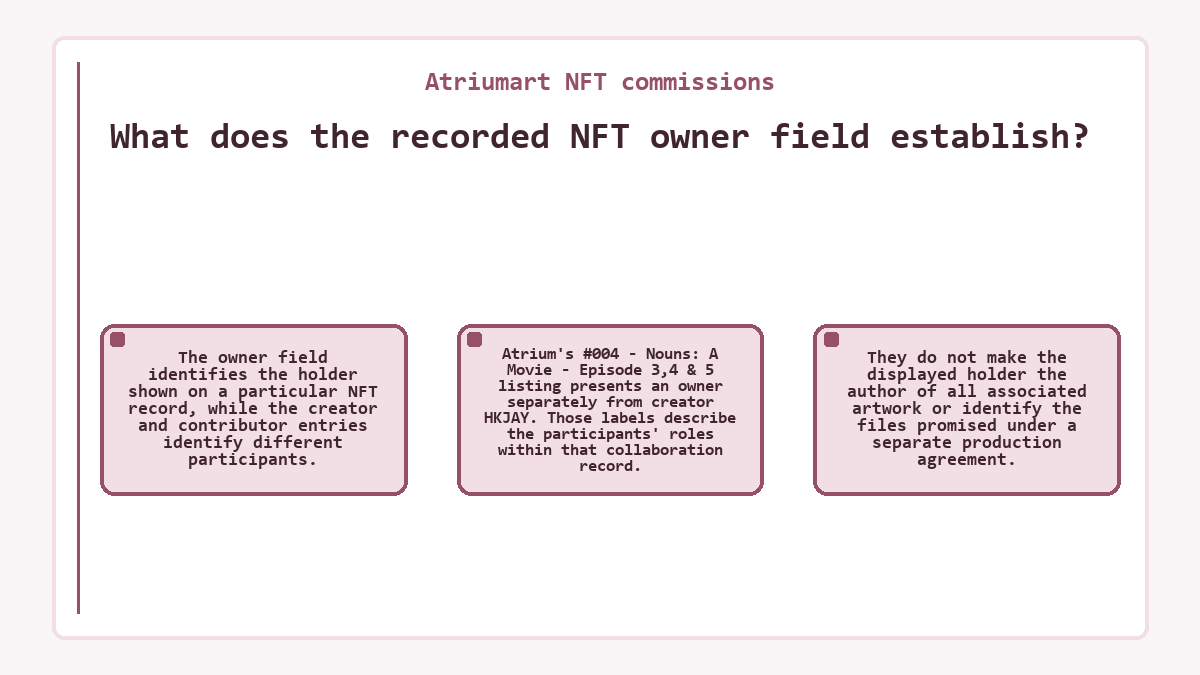
What does the recorded NFT owner field establish?
The owner field identifies the holder shown on a particular NFT record, while the creator and contributor entries identify different participants. Atrium's #004 - Nouns: A Movie - Episode 3,4 & 5 listing presents an owner separately from creator HKJAY. Those labels describe the participants' roles within that collaboration record. They do not make the displayed holder the author of all associated artwork or identify the files promised under a separate production agreement.
Artist credits by production role
Artist credits need to retain the contributor's actual role, especially when a single NFT record represents collaborative animation or other production work. HKJAY appears as creator on the Nouns episode collaboration. The same collaboration credits Batmax for environment modelling and texturing.
The record also indicates additional artist participation. A commission handover can carry more detailed acknowledgements than the short creator field. Keep those acknowledgements attached to the particular artwork and the role performed, so the credit line preserves each person's contribution.
Role wording matters when a commission includes more than visual artwork. Atrium's roster includes composer Jakub Pietras alongside artists working in creative direction and 3D production. Those disciplines describe different work and need suitable credits when included in the commissioned delivery.
A credit line passes when names and roles match the agreed contributions. Missing a specialist leaves that attribution incomplete. Limit each description to the contribution it actually names.
Sale records and production completion
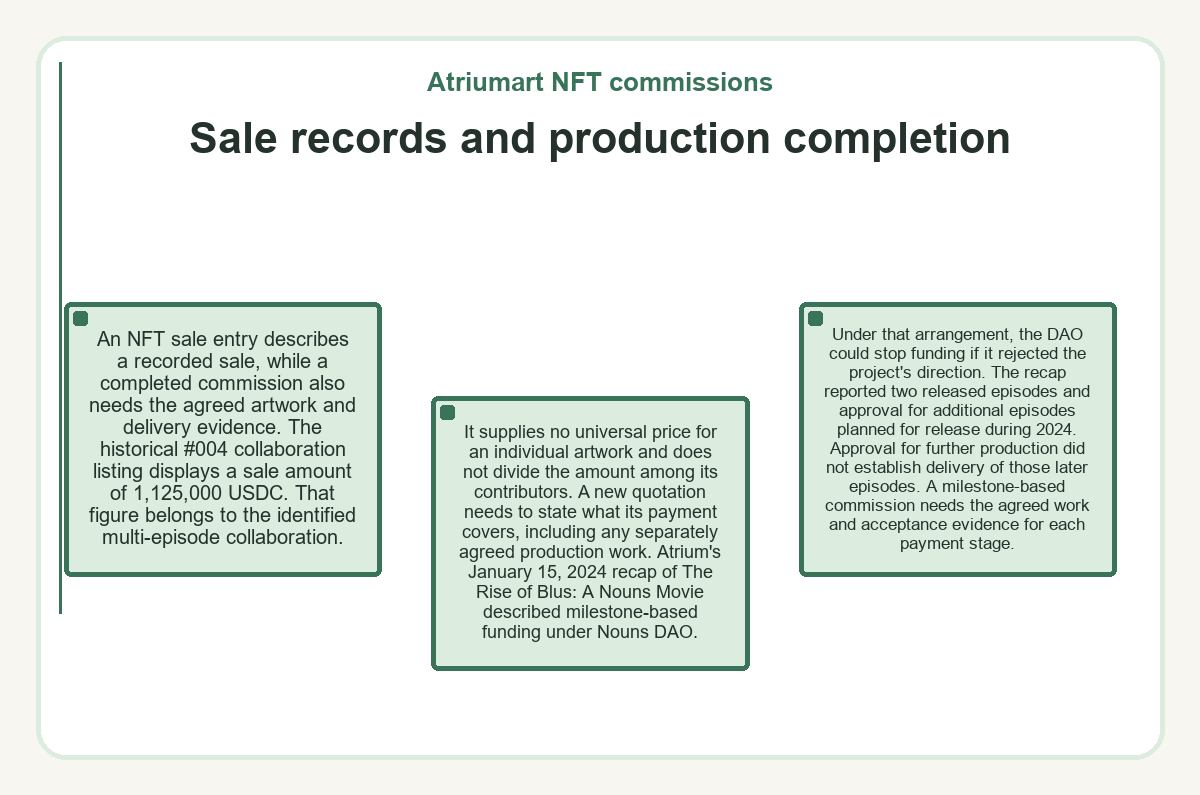
An NFT sale entry describes a recorded sale, while a completed commission also needs the agreed artwork and delivery evidence. The historical #004 collaboration listing displays a sale amount of 1,125,000 USDC. That figure belongs to the identified multi-episode collaboration. It supplies no universal price for an individual artwork and does not divide the amount among its contributors. A new quotation needs to state what its payment covers, including any separately agreed production work.
Atrium's January 15, 2024 recap of The Rise of Blus: A Nouns Movie described milestone-based funding under Nouns DAO. Under that arrangement, the DAO could stop funding if it rejected the project's direction. The recap reported two released episodes and approval for additional episodes planned for release during 2024. Approval for further production did not establish delivery of those later episodes. A milestone-based commission needs the agreed work and acceptance evidence for each payment stage.
A corrected credit line at handover
Consider a hypothetical handover summary for the documented Nouns episode collaboration. It labels the recorded owner as the creator and leaves out the environment artist.
Check each claimed role against its corresponding listing entry. The ownership entry identifies the holder; production credits come from the creator and contributor entries. The expected wording names HKJAY as creator and Batmax for environment modelling and texturing.
The summary fails because it substitutes ownership for a production role. A corrected line reading "HKJAY, creator; Batmax, environment modelling and texturing" matches the documented attribution. Accepting the corrected credit line leaves delivery of the commissioned files and any agreed token transfer unconfirmed.
Human commissions and AI output rights
Atrium AI's input and output terms affect the permissions for commission assets generated through that service. Hyype Inc's Terms of Service and License Agreement, revised October 20, 2025, address submitted inputs and generated outputs. Subject to compliance with those terms, the company assigns users its rights in generated outputs. Users remain responsible for input permissions and third-party rights. That assignment concerns the company's rights in an output; it does not clear every right in material a customer uploads.
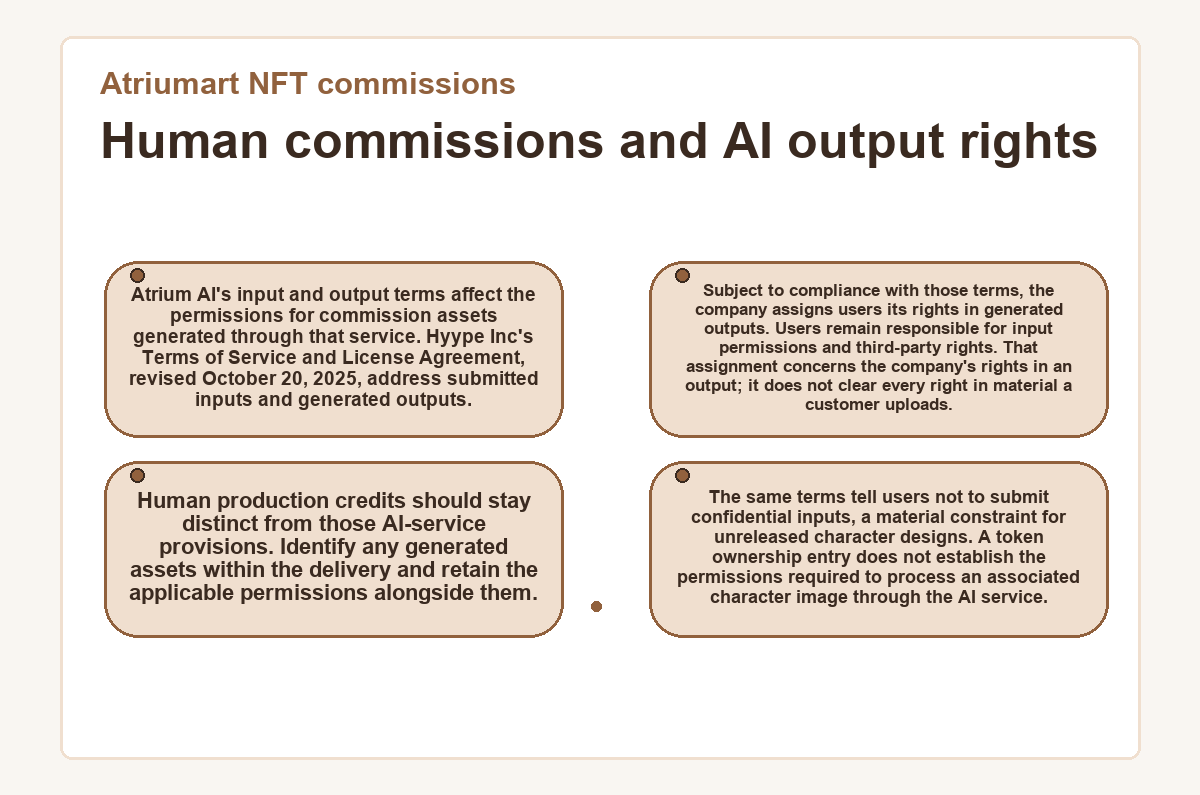
Human production credits should stay distinct from those AI-service provisions. Identify any generated assets within the delivery and retain the applicable permissions alongside them. The same terms tell users not to submit confidential inputs, a material constraint for unreleased character designs. A token ownership entry does not establish the permissions required to process an associated character image through the AI service.
Things people ask
Should an Atrium NFT commission quote identify its payment currency?
The quote should name the asset or currency and the work the payment covers. The recorded Nouns episode collaboration displays a sale in USDC. That historical denomination describes the specified sale; it does not establish a required payment currency for every new commission.
Do Atrium NFT commissions always produce one-of-one artwork?
A one-of-one description needs to apply to the particular commissioned asset and its edition. 3dprintguy's Slice of Life description includes plans for a series of 1/1 works within a shared world. That collection-specific description does not establish an edition policy for every Atrium commission.
Are revisions unlimited in an Atrium NFT commission?
The revision allowance needs to be stated in the project agreement. 3dprintguy describes Atrium's commission process as including time for questions and communication with the collector. That describes creative discussion without establishing an unlimited revision commitment. Distinguish corrections within the agreed scope from requests for additional production work when specifying the review arrangements.
Does commissioning an Atrium NFT establish resale royalties?
Resale royalties need terms specific to the commissioned NFT or its licensing arrangement. Hyype Inc's October 20, 2025 terms contemplate future features for licensing content through publicly released AI models, with any compensation subject to updated terms. That conditional provision concerns a different arrangement and does not establish NFT resale royalties. Any continuing compensation needs its own applicable terms.
What happens to AI-assisted commission assets after account deletion?
Hyype Inc's terms allow the company to delete user content after account deletion or termination of access. The October 20, 2025 agreement makes deletion under that clause optional. Users no longer using paid services may separately request full data removal. Atrium promises written confirmation of completed deletion within 30 days of receiving that request. An AI-assisted commission's handover therefore needs to identify the assets actually delivered, without assuming the service account will remain a permanent archive for the customer's work.